
Blog
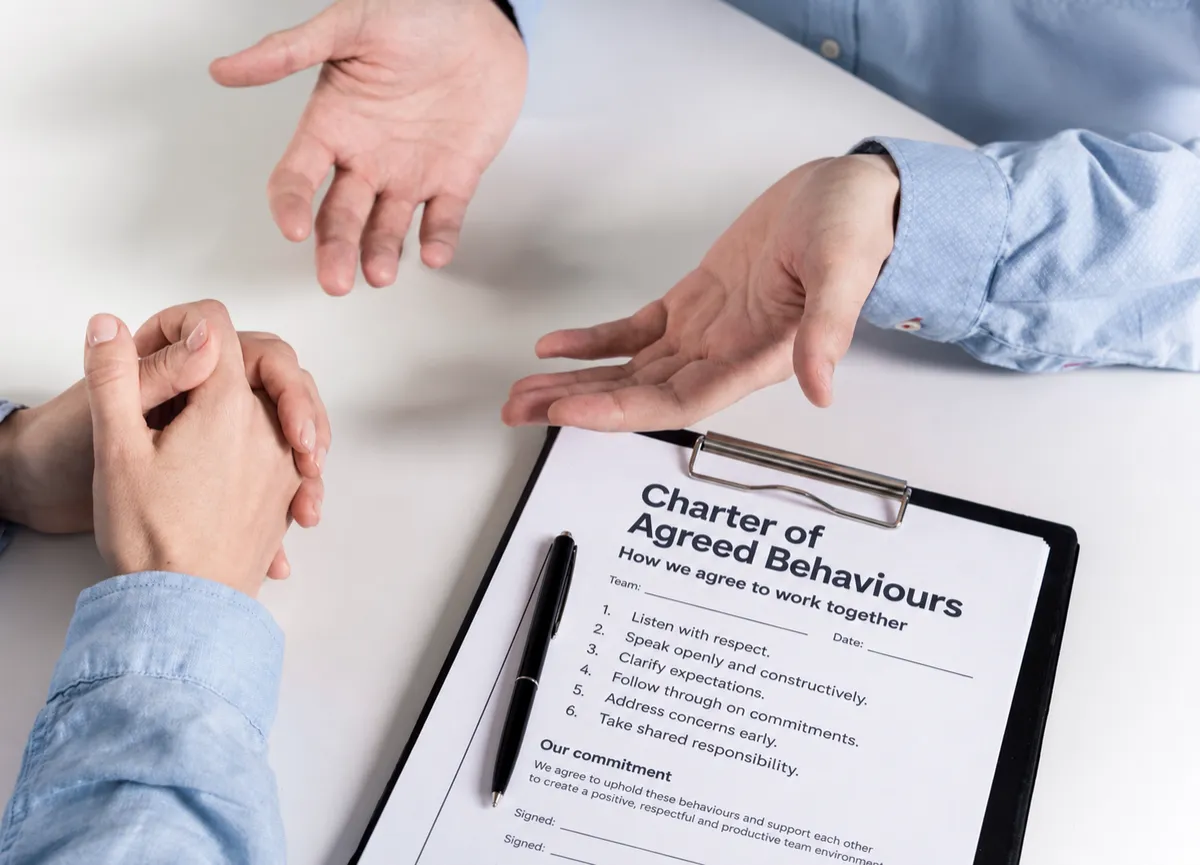
Before You Set the Rules, Involve the Team
Imagine an organisation has a value that says:
“We value work-life balance.”
But managers regularly send emails at 10 pm, and the people who respond immediately are seen as committed to their work.
Which message will people believe? The value written on the website, or what they see happening around them?
Most of us learn pretty quickly that what happens in practice means more than what is written in a policy or displayed on a wall. The same thing happens with words such as respect, trust, professionalism, collaboration and accountability.
A team may genuinely agree that these things are important, while having very different ideas about what they look like day to day.
Someone might think good communication means being direct and getting quickly to the point. While someone else might need time to reflect before contributing. Some people will challenge an idea during a meeting, while others will think about it and raise their concerns afterwards.
None of those approaches mean that someone is being difficult or disrespectful. It often means the team hasn’t had the conversation about what it expects from one another.
That conversation is where a Charter of Agreed Behaviours becomes useful.
What we say and what people experience are not always the same
There is a useful way of thinking about this in the work of Edgar Schein, the late MIT Sloan professor who spent decades studying organisational culture. Schein described culture as operating at three levels.
Put simply, we might think about them as:
1. What you see
The visible signs of culture. Meeting habits, everyday interactions, how decisions are made, whose voices are heard and what behaviour is recognised or rewarded.
Schein called these artifacts.
2. What we say
The values, goals, policies and principles an organisation says are important.
Schein described these as espoused values.
3. What people believe
The assumptions people gradually come to take for granted about “how things are done here”.
These are Schein’s basic underlying assumptions.
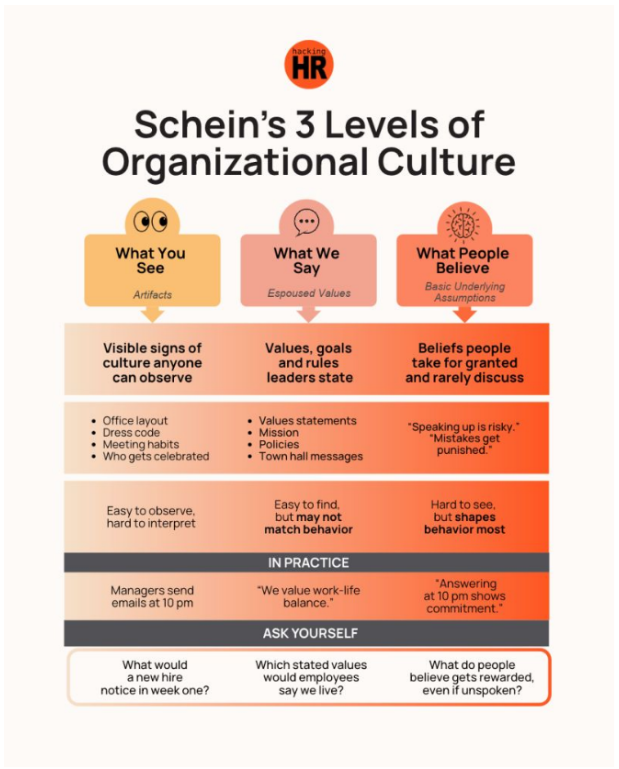
An organisation might say, “We value work-life balance. ”People might see managers sending emails at 10 pm. Over time, the unspoken belief can become:
“Answering at 10 pm shows commitment.”
That belief was probably never written into a policy. Nobody necessarily sat down and decided it should become part of the culture, right? Yet people learn from what they see repeated.
Culture is communicated through behaviour, not just values statements.
The same gap appears in everyday teamwork
Take a common workplace value:
“We treat each other with respect.”
If I had a dollar for every time I’d seen that sprouted as company values. I mean who’s going to object to that? But what exactly does respect mean when two people disagree? It’s so open to interpretation.
Does it mean allowing someone to finish speaking before responding?
Does it mean asking questions before challenging their position?
Does it mean being able to disagree openly in a meeting?
Or does it mean raising a difficult issue privately?
What about accountability?
Does accountability simply mean doing what you said you would do?
Or does it also mean letting colleagues know early when you realise you can't meet a commitment?
What does collaboration look like when there is time pressure?
What happens when somebody has a different opinion from the leader?
These are the conversations that show the gap between a value and a behaviour. Without those conversations, people fill in the gaps themselves, drawing on previous workplaces, personal experiences and their own expectations. That is often where misunderstandings begin.
A charter brings values down to the level of behaviour
When difficulties emerge, the response is often to introduce another process, create a new rule or remind everyone that they need to “communicate better”. The trouble is, communicate better isn't very helpful. Neither is ‘be respectful’.
People can agree completely with the words and still disagree about the behaviour. A Charter of Agreed Behaviours takes the conversation one step further.
Instead of: We will treat each other with respect.
A team might agree: We will allow people to finish speaking before responding.
Instead of: We value collaboration.
The team might decide: Before making a decision that affects another person's work, we will involve that person in the conversation.
Instead of: We value accountability.
They might agree: If we cannot deliver something we have committed to, we will let the people affected know as early as possible.
Instead of: We communicate openly.
The agreed behaviour could be: We will raise concerns constructively with the person involved rather than first discussing the problem with other people.
The difference may seem small, however when it’s put into practice, it can create significant change in workplace culture.
People now have something tangible and observable that they can practise. It means it’s recognisable and they can come back to it when things become difficult.
The conversation matters as much as the charter
It can be tempting to create a charter for a team and present it as the new way everyone is expected to work. However, that misses one of the most useful parts of the process.
The conversation involved in creating the charter is as important as the finished document.
When team members discuss what respect, communication, participation, disagreement and accountability actually look like, assumptions can begin to come up. That’s not a bad things, because we then have something tangible to work with.
Someone may say: “When people interrupt me, I stop contributing.”
Someone else might say: “I interrupt because I'm enthusiastic and I hadn't realised that was the impact.”
Another person might point out: “We say we want people to speak up, but when somebody questions a decision, the conversation shuts down.”
This is where Schein's model becomes particularly useful.
You can ask a team:
What do we say? As in, what values and behaviours do we claim are important?
What do we see? As in: what actually happens in our meetings, emails, conversations and decisions?
What might people therefore believe? As in: what would a new team member learn about “how things are done here” simply by watching us?
Maybe that third question can be uncomfortable, yet it can also be enormously useful.
Give everyone a way into the conversation
The process needs to allow more than the quickest or most confident voices to shape the agreement. For an in-person workshop, small groups can rotate between sheets of paper headed with topics such as:
Respect
Communication
Accountability
Disagreement
Participation
Decision-making
For an online team, the same activity can work using Microsoft Teams breakout rooms and a shared Microsoft Whiteboard.
Importantly, the task isn't: “Write down what everybody else should do.”
It is: “What are we prepared to commit to doing ourselves?”
That small difference changes the conversation from correcting other people to taking shared responsibility for how the team works.
Put the proposed behaviours to the test
A charter doesn't need to cover every possible situation. In fact, a long list of ideal behaviours is likely to become another document people stop noticing.
A shorter set of specific agreements is far more useful.
For each proposed behaviour, ask:
Can we see or hear this behaviour?
Is this realistic when we are busy or under pressure?
Are leaders prepared to model it too?
And perhaps most importantly, the question we want to ask is: Could we genuinely hold ourselves and each other accountable for it? If the answer is no, keep working on the wording.
“Communicate respectfully” may be difficult to hold someone accountable for. For example, “We will challenge the idea rather than criticise the person” gives the team something much clearer to work with.
Look for the gaps
Once a charter is in place, Schein's three levels offer another useful check.
Level | Question for the team |
What we say | What have we agreed is important? |
What we see | Do our everyday behaviours actually reflect that? |
What people believe | What are people learning about what is really expected or rewarded here? |
Suppose a charter says: “Everyone's contribution is welcome.” Yet the same three people dominate every meeting.
Or: “It is safe to raise concerns. ”Yet difficult questions are routinely dismissed or avoided.
Or: “We respect people's time outside work. ”Yet late-night messages receive praise for responsiveness.
The charter isn't necessarily the problem; the gap is the useful information. It tells the team where the stated expectation and the lived experience have moved apart.
A living agreement, not something on the wall
Creating a charter is only the beginning. Teams change. New people arrive. Responsibilities move. Pressure increases. Behaviours slip.
The charter needs to come back into ordinary team conversations. It can simply be a check in, “We agreed that we would do this. Are we still doing it?” Leaders have a particular responsibility here. If the stated behaviour applies to everyone except the person leading the team, people will notice that very quickly. They will learn from the behaviour rather than the words.
Which brings us back to Schein.
What people see, what an organisation says and what people come to believe are closely connected. A Charter of Agreed Behaviours can help bring those three things closer together because it turns broad values into choices people can actually see in everyday work.
Teams become stronger when people have discussed how they have agreed to behave when disagreement, pressure and difficulty inevitably arrive.
So, before introducing another rule or asking people to “communicate better”, bring the team together and ask:
What do we say is important?
What would somebody watching us actually see?
And what might they conclude about how things really work around here?
Then ask one final question: How do we want to behave with one another, particularly when the work becomes difficult?
The answers are a very good place to begin.
What's Next?
If you are leader wanting to improve your leadership capabilities or a HR professional wanting to improve capabilities of you leadership team, I can provide you a free strategy session to find solutions that work for you or your team.
Check out our upcoming free masterclasses that focus on how to Feel Good at Work, how to work Better Together, Talk Smart (communication techniques), Mission Control (leadership techniques), Essential Human Skills, and how to Tame Your Time.
Want more like this?
We send the odd useful email with content like this. If you'd like more like useful tools, tips and advice, subscribe here.

Stay Ahead with Practical Leadership & Time Management Insights
Subscribe to receive professional development tips, leadership strategies, stress management insights, and updates from Barbara Clifford & the Hinwood Institute.
Contact
PO Box 509 Alice Springs, NT 0870 Australia


Legal
© 2026 The Hinwood Institute. All rights reserved.
Designed & Developed by True Blue