
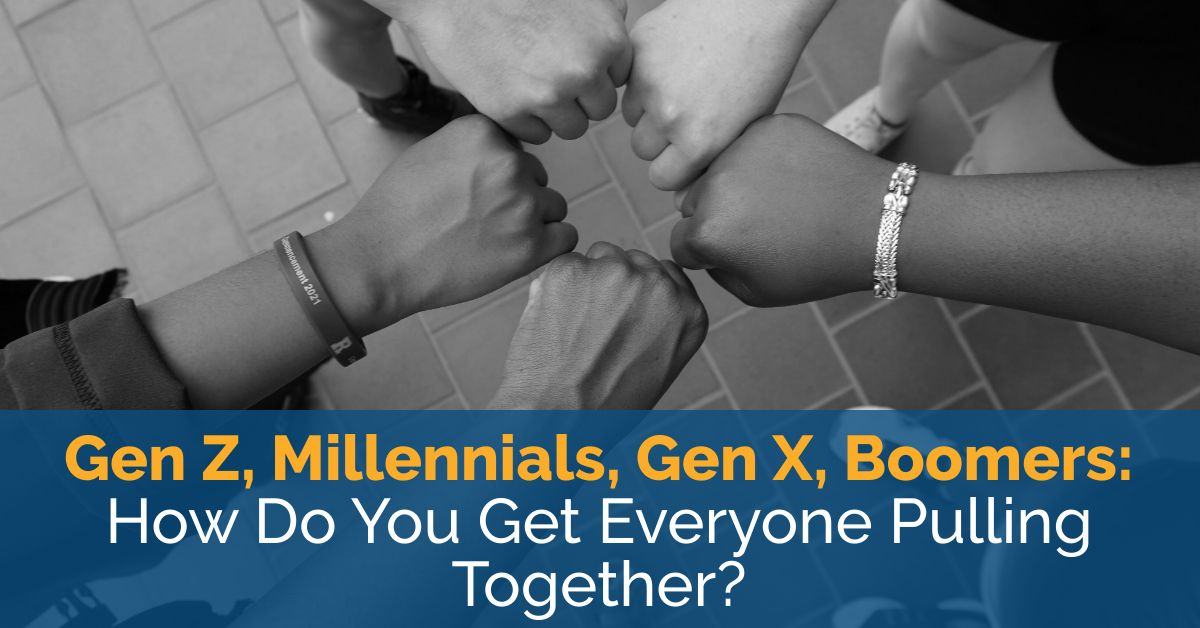
Gen Z, Millennials, Gen X, Boomers: How Do You Get Everyone Pulling Together?
The reality is that for the first time we have five generations working side by side: the Silent Generation, Baby Boomers, Gen X, Millennials, and Gen Z. Each brings different values, communication styles, work ethics and life influences, which means generational diversity isn’t just about age but about the era that shaped people.
When we unpack generational definitions, we find two key ways to look at them:
- By birth-year brackets (rigid demographics)
- By the social, cultural and economic influences present when people entered life, career, leadership.
For example: the “Baby Boomers” label relates to the post-WWII surge in population and a culture of connection, celebration and rebuilding. By contrast, Millennials arrived as the “dot-com” era unfolded. So, it’s not always about the exact birth date, sometimes it’s the landmark experiences that formed a generation’s mindset.
For leadership and workplaces this means names like “Millennial” or “Gen Z” are shorthand for a mix of influences, not necessarily a fixed personality type.
Why is generational diversity important for modern workplaces?
Generational diversity is important because multiple age clusters bring different perspectives, skills and expectations. When managed well, that mix can enhance innovation, productivity and adaptability. However, if assumptions and stereotypes take over, that same diversity can lead to misunderstandings and conflict rather than strength.
Research from Centre for Work, Organisation & Wellbeing at Griffith University, found high-performing multi-generational workplaces tend to:
- Provide age-diversity and inclusion training.
- Use inclusive communication methods (face-to-face, digital, hybrid) so all generations are reached.
- Promote mentoring opportunities across generations.
At the same time, international research (for example from McKinsey & Company) suggests the focus needs to be on individuals, not just their generation label.
If you’re leading teams, this means you could have a great untapped resource in of diverse age experiences. The challenge is creating the right environment for all voices to be heard and valued.
What risks come from stereotyping generations at work?
The reality is stereotyping generations (for example saying “Gen Z are lazy” or “Boomers can’t use tech”) creates a workplace culture that accepts bias, limits inclusion, undermines engagement and may even contravene age-discrimination law.
Here are some of the risks that could happen if we pigeonhole generations:
- Older workers might be excluded from training or new projects on the assumption they “won’t cope”.
- Younger workers may be labelled entitled and then their insights discounted.
- Communication breaks down because assumptions replace curiosity.
- Psychological safety suffers: people may not speak up if they feel judged for their age.
- Potential legal risk: age discrimination laws (in Australia) apply if negative assumptions lead to poor treatment of an employee because of their age.
As a mediator, it’s not uncommon to see assumptions being one for the root causes for a breakdown in trust or collaboration.
How do generational influences shape work behaviour and values?
Generational influences can impact how people view work, career progression, communication, authority and technology. Now this is not specifically because of their age, but because of the era they grew up in. For instance, growing up during economic recession, war or rapid tech change can impact your mindset.
- Typical factors that shape a generation:
- Historical events: e.g. war, economic crisis, pandemic. These form early life experiences that shape people’s attitude to risk, their loyalties or their change in appetite for things.
- Technology exposure: Whether someone is an early adopter or late adopter, can influence people’s comfort with innovation, communication channels and expectations.
- Social norms: Cultural expectations about work, career, gender and leadership evolve across time.
For example, working families of today, are time poor and cooking healthy meals at home has become a challenge. It’s no surprise to see cooking appliances like slow cookers or Thermomix taking replace the long held value of “doing it the long way” of traditional, wholesome food preparation.
When leading a mixed-age team you can ask: What influences shaped you? What behaviours make most sense in this era? That kind of question invites dialogue rather than assumption.
Simple Strategies for Effective Cross-Generational Communication
| Strategy | What it does |
| Open-ended questions | Encourages dialogue, reduces defensiveness |
| Multi-modal communication | Ensures all generations are reached |
| Mentoring & reverse-mentoring | Builds cross-generational connection |
| Outcome-focused conversation | Reduces “us vs them” method conflicts |
| Reflection & assumption-checking | Surface hidden bias and improve leader self-awareness |
| Psychological safety & inclusion | Enhances team trust and performance |
How do generational differences relate to leadership and change ?
In some smaller businesses or organisational departments, where environments may be tightly knit and roles multifaceted, generational diversity offers a rich leadership opportunity, yet also a unique challenge. Leaders need to manage not only age-related differences, but also locality, cultural backgrounds, resource limitations and rapid change.
At the Hinwood Institute, we work with different types of leaders in different types of situations, these are some additional dynamics to consider:
- Mixed generations may include people born and raised locally, vs those who have relocated. Their values about community, work-life balance, career may differ.
- Access to training, technology and networks may vary in different regions. Older workers might feel left behind; younger ones may expect more agility.
- Leadership succession in smaller or regional businesses may follow family/ties traditions (intergenerational). Addressing generational mindset becomes central to sustainability.
The take-away message for leaders managing multi-generational teams
The reality is that managing generational diversity isn’t about labelling or boxing people by age. It’s about curiosity, defining respect and creating space for all voices. When you lead with genuine interest and design environments where generational differences are seen as strengths, you build resilient, high-performing teams.
As you step into your role leading or designing training for executive leaders, keep this in mind:
- When you hear a comment like “You young people don’t want to wait a year for a promotion”, remember, you might have requested something similar in your 20s.
- When you notice a manager avoiding involving a ‘Boomer’ in new tech planning because “they wouldn’t understand”, challenge the assumption.
- Use your ‘safe conflict’ skills to bring generational dialogue into team conversations: What does this generation value? How might another see it differently?
By being mindful with these dynamics, you help teams use generational differences as a source strength diversity and innovation.
Check out our upcoming free MASTERCLASSES that focus on how to Feel Good at Work, how to work Better Together, Talk Smart (communication techniques), Mission Control (leadership techniques), Essential Human Skills, and how to Tame Your Time.
If you want to improve your behavioural skills and master the human side of work, book your free strategy session here.


Listen to Podcast Here:
About the Author
